

Helpful Tips For Pickleball Conversion
Interest in pickleball continues to grow, and many communities are exploring ways to convert existing tennis courts into pickleball courts. With participation increasing dramatically over the past decade, adding pickleball has become one of the most requested recreational amenities. However, before moving forward, there are several important factors to evaluate.
- First and foremost is to determine the existing condition of the playing surface. Does it require a simple color-coat resurfacing, or are crack repairs or a full rehabilitation needed? Many courts are constructed of hot mix asphalt and the asphalt does need to be rehabilitated from time to time. This could consist of the application of another layer of asphalt over the existing or in some instances, removal and replacement of the existing materials.
- Drainage of the playing surface should be reviewed. Ponded water on the playing surface can have a negative impact on the playability of the courts as well as their long-term performance. Often times ponded water can be addressed during the color-coat application while other, in more severe cases, more significant modifications or reprofiling might be needed.
- Will the pickleball courts be simply striped into an existing tennis court or will the pickleball courts replace a tennis court? The size and layout of the two courts are different as well as net heights. Because pickle ball courts are considerably smaller than tennis courts, two tennis court battery can be readily converted into four pickle ball courts
- Do fencing or wind screens need to be added to provide more desirable playing conditions. While fencing is not required in most cases, it can afford a better playing environment.
- Sound impacts should also be considered. Pickleball does come with a noticeable sound difference in sound from play.
Converting existing tennis courts into pickleball courts can be an excellent investment that increases community engagement and recreational opportunities. Every site is unique, so a thorough evaluation of the existing facilities will help determine the most cost-effective approach.
Our team would be happy to assess your courts and help identify the best solution for your community.
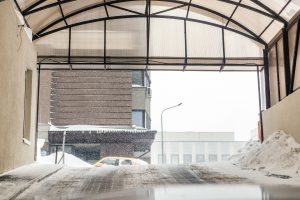 Proper removal of snow from a parking garage is usually the first thing on the owner’s mind after a snowstorm to the allow the garage’s top deck to become operational again. However, some owners may not realize that improper removal of the snow could jeopardize their structure, particularly if all the snow is stored on a single location on the top deck. Most buildings within the surrounding area are designed to withstand a code-prescribed snow load of approximately 30 pounds per square foot (psf). However, stacking large amounts of wet, melting snow in a concentrated area can cause loads double or triple the design load to be applied to the structure, risking its structural integrity and, in the worst case scenarios, leading to failure.
 When the summer heats up, we often begin looking for methods of keeping things cool while outdoors. Whether we are trying to cool our gardens, our structures, or ourselves, water is considered one of the most effective tools in this regard. But not all things will benefit from added water, even on a hot summer day.
 We have found paving fabrics to be very useful in pavement rehabilitation. However, it’s important to apply a proper thickness of asphalt over the fabric or premature failures can occur.
 When evaluating asphalt pavement, including asphalt-paved parking decks, ETC recommends core sampling as part of our investigative service. Extracting a core sample of the pavement can be beneficial in telling the history of the pavement construction as well as the conditions of the sub-base profile beneath the asphalt.
 Unfortunately, there isn’t a quick fix for addressing footprints in your


 Imagine a winter without the need for ice melt. Researchers at Drexel, Purdue and Oregon State University are working with concrete admixtures to hopefully make this a reality. Their research includes the addition of phase changing materials such as paraffin, coconut, or palm oils into the concrete mix and has proven to melt snow in certain conditions. The phase change materials release thermal energy as they solidify, meaning as the temperature drops, they release heat, which melts the snow. The inclusion of the phase changing materials in the concrete mix result in a one-time cost at construction rather than reoccurring costs, such as electricity, in cases where heating elements are embedded in concrete for snow melting. More information on the research can be found at the following link: http://drexel.edu/now/archive/2017/September/self-melting-concrete-roads/.
 Parking garages in this region are attacked by road salts and water throughout much of the year. The cost to repair deteriorated concrete can be quite high and the project can cause significant inconvenience to garage users. So, as part of a parking garage restoration project, we recommend and our clients tend to include, application of a vehicular-traffic-bearing membrane on the structural slabs to help protect their investment and extend the service life of the garage.


 Is your concrete peeling or flaking in localized areas? Are you noticing rough, aggregate surfaces in your concrete that haven’t been there before, particularly after the latest round of winter weather? If so, your concrete may be experiencing a condition called scaling.