

Concrete Evaluation by Thermal Imaging
 Have you ever seen someone tapping a concrete wall with a hammer? Or dragging a chain along a concrete floor? These are a couple of the conventional methods for evaluating concrete- that is, identifying and locating unsound or “loose” concrete. These methods are known to be noisy and typically require close-up, physical access to the concrete surfaces. You might wonder is this the only efficient way to evaluate concrete?
While there are numerous contemporary alternatives for surveying and evaluating concrete, many of these methods have limitations in cost, accuracy, or both. One method that has proven its accuracy and is already a well-developed technology is thermal imaging. Infrared cameras have been used to depict thermal images since the 1960s. Over the history and development of these cameras, they have been effectively applied in many industries including medical (detection of fevers), military and law enforcement (surveillance), firefighting, and many others. Recently, the technology of thermal imaging has found success in yet another application: evaluation of concrete structures.
Infrared cameras detect thermal radiation, or heat, and translate the radiation into a thermal image that the human eye can see. We can then understand temperature differences by the colors depicted in the image. Unsound concrete typically traps air beneath its surface. Since air heats up and cools down much faster than many solid materials, including concrete, a temperature difference between sound and unsound (delaminated) concrete is created and can be detected by an infrared camera. The thermal image produced by the camera will show a hot spot in the morning as the ambient temperature is rising, and it will show a cool spot in the afternoon as the temperature begins to drop.
Although thermal imaging applied to concrete structural evaluations has its own limitations (e.g. training required for the thermographer, availability of equipment, ambient temperature differences), it can serve as an accurate alternative to the conventional hand-sounding methods. For more information on this topic from a certified infrared thermographer, feel free to email spenn@etc-web.com.


 Two recurring complaints of residents in multi-family buildings are related to

 As Hurricane Dorian bears down on the Atlantic Coast, many are preparing for its arrival. It seems like common sense to be sure that all exterior windows and doors to your house/building are closed. In fact, studies have shown that open windows/doors increase the wind pressure acting on a building roof, beside letting in the rain to damage the building interior. This led to the development of so-called Hurricane Windows. These windows can resist the force of a flying 2×4 and other debris so that the wind and rain do not enter the house.
 Words can have a number of meanings and can even change meanings with time. This is especially true of terms specific to a technology or industry. Following are definitions of a few roofing and paving terms that people outside those trades (such as board members) may hear and not fully understand.


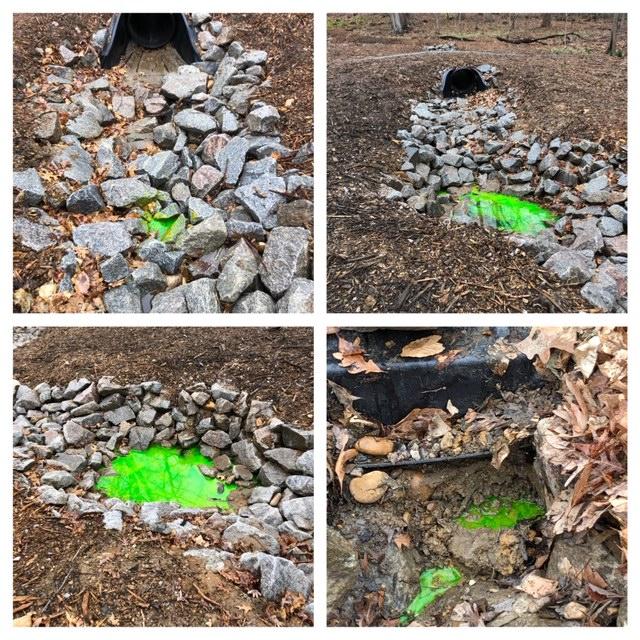
 This is not a radioactive fluid spill! We just used a fluorescent green biodegradable dye to see if water was flowing under, rather then through the culvert. It turned out that water was flowing under the pipe through the gravel setting bed. We have more dye left if you need to know where water is coming from or going to.
 Alfred Hitchcock had bird issues (especially seagulls), but in the Baltimore-Washington area, the most common pest birds are pigeons, house sparrows, and starlings. These birds are undesirable if they land, roost, and nest on or in our buildings because they bring unwanted noise, odor, and often disease. Plus, no one likes their deck, patio, lawn furniture, or other belongings adorned with bird droppings.
 Have you ever seen that yellow sign before driving over a bridge that says, “

 Landscape Infiltration devices have become a favored method of controlling and filtering sediment and pollution carried by rainwater runoff, replacing large sediment ponds previously used. Landscape infiltration devices utilize beds of sand, gravel and mulch, along with native plantings to filter the runoff before the water enters the stormwater system. When completed, the area appears to be a nicely landscaped section of the property.